Research on Walking, Getting Lost, and Being Swept Along as Art Practice
Research on Walking, Getting Lost, and Being Swept Along as Art Practice
Department of Intermedia Art, Graduate School of Fine Arts, Tokyo University of the Arts (Tokyo and Ibaraki, Japan) / École nationale supérieure des Beaux-Arts de Paris (Paris, France)
2022–
Research project
Walking is slow, tedious, and dull. That is precisely why it gives us the freedom to get lost. In a society where efficiency and productivity are treated as absolute values, and where our attention is constantly seized by a never-ending stream of information, we are unknowingly swept along in a certain direction. Is there a way of behaving that neither surrenders completely to that current nor keeps resisting it? From 2022 to the present, I have been thinking through this question by way of walking, an act common to all of humanity.
Before becoming involved in art, from 2016 to around 2020, I ran my own media outlet under the title “Professional Unemployed.” I visited people who were already making a living from what they loved and asked how they had arrived at that work, going all the way back to their upbringing and formative experiences. I edited these conversations into articles of 3,000 to 4,000 characters or videos of 10 to 20 minutes and published them. My motivation was to offer a generation who, like my former self, could not find a dream or goal, options that did not appear on the existing list of occupations. I compiled the 100 people I interviewed into a zine, The 100 interviews (2020).
As I kept going, however, I fell into the dilemma of media work, which can never escape page views and view counts. A single person’s life is long, complex, and diverse, yet what works as an article is a few thousand characters, or a dozen or so minutes of video. With every cut, the surrounding context fell away, and I felt that the most important things were left on the side I had cut. There are rules of thumb for choosing headlines and images that “go viral,” and the more closely I followed them, the more the fine details of thoughts and feelings were simplified, sometimes spreading in a different form altogether. I had wanted to convey that there are many ways to live, but in practice I may have ended up promoting a single set of values. Was there a way to present complex things as complex, without converting them into words or numbers? That question led me to art.
Around the same time, I became interested in Buddhism, especially Zen, and in 2020 I moved my base to Kanazawa to read D. T. Suzuki and Kitaro Nishida, who, like me, came from Ishikawa. Their thought does not separate self and world, subject and object, from the outset. Social media, born in the West, by contrast sharply divides those who see from those who are seen, the self who posts from the others who receive. It looks like a mechanism that transposes the Cartesian separation of subject and object directly onto the internet. I came to think that the feeling that I was growing bigger as my numbers grew, and the feeling that each time I posted something in definitive words I was deepening division and taking part in it myself, came from this mechanism. So I entered the Department of Intermedia Art at the Graduate School of Tokyo University of the Arts, with “a way of living without dividing into anything” as my research theme.
The method I focused on was walking. The trigger was Rebecca Solnit’s Wanderlust: A History of Walking. Solnit describes the ideal of walking as a state in which mind, body, and world begin a conversation, and the notes the three play sound an unexpected chord. In contrast to a life spent moving between fragmented interiors—home, car, office, shop—on foot everything is continuous, she writes; the walker dwells even in the gaps between spaces and lives in the whole of the world. The body must carry out work that the mind does not want to do: everyone experiences this split between body and thought in daily life. Yet while we move forward by our own will and our own steps, the two are organically connected, and we can regain an active relationship with the world. Here was an extremely concrete way of remaining undivided.
The research proceeded around several texts: Henry David Thoreau’s “sauntering” and “the wild”; Michel de Certeau’s view that pedestrians are the true “practitioners of the city,” whose detours and shortcuts are tactics; and Tim Ingold’s distinction between “transport” and “wayfaring.” The lineage that treats walking itself as a creative practice runs from Baudelaire’s flâneur and Benjamin’s theorization of it to Richard Long, Hamish Fulton, and Francis Alÿs.
For a year from 2023, I studied on exchange at the École nationale supérieure des Beaux-Arts de Paris, researching and making work at the birthplace of this lineage. I drew in particular on the “psychogeography” and “dérive” of the Situationist International centered on Guy Debord. Their critique, which named a society in which all of life exists only as representation “the spectacle,” seems all the more valid today, when algorithms optimize and deliver our experiences. That is what I thought as I actually walked the streets of Paris, a city of revolution and a city of pedestrians.
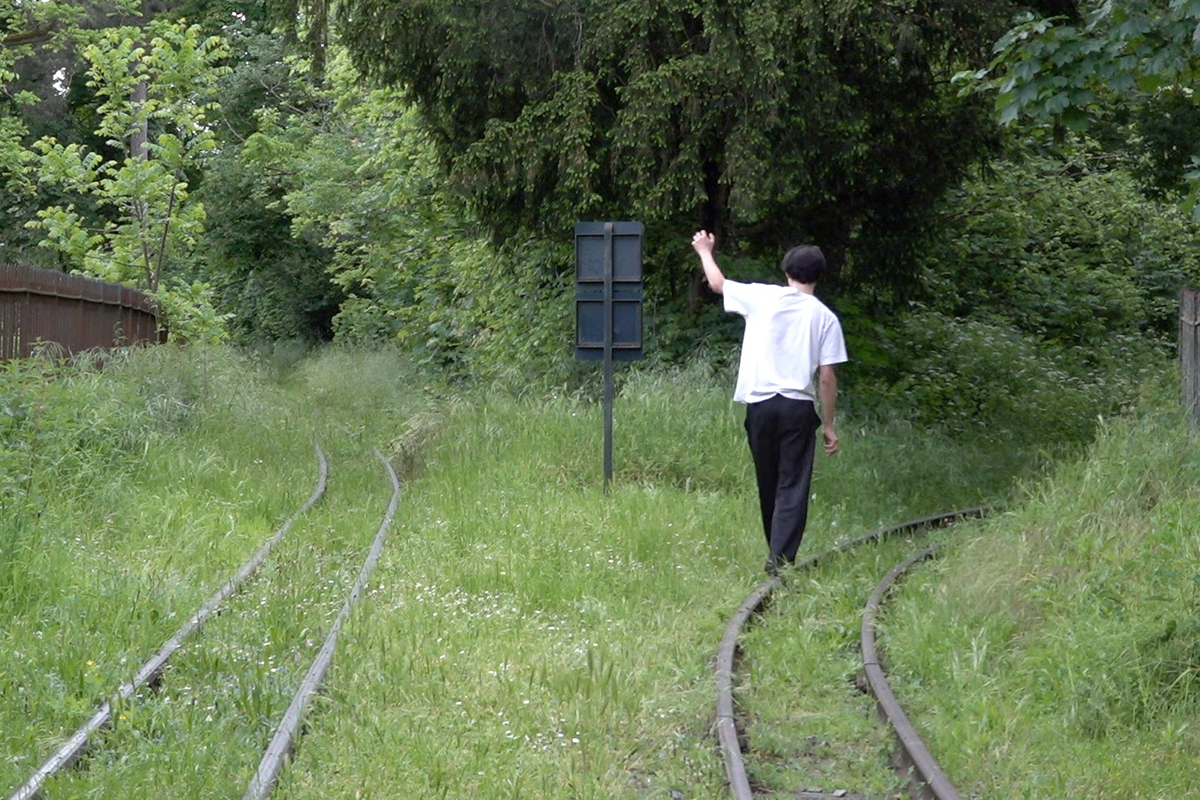
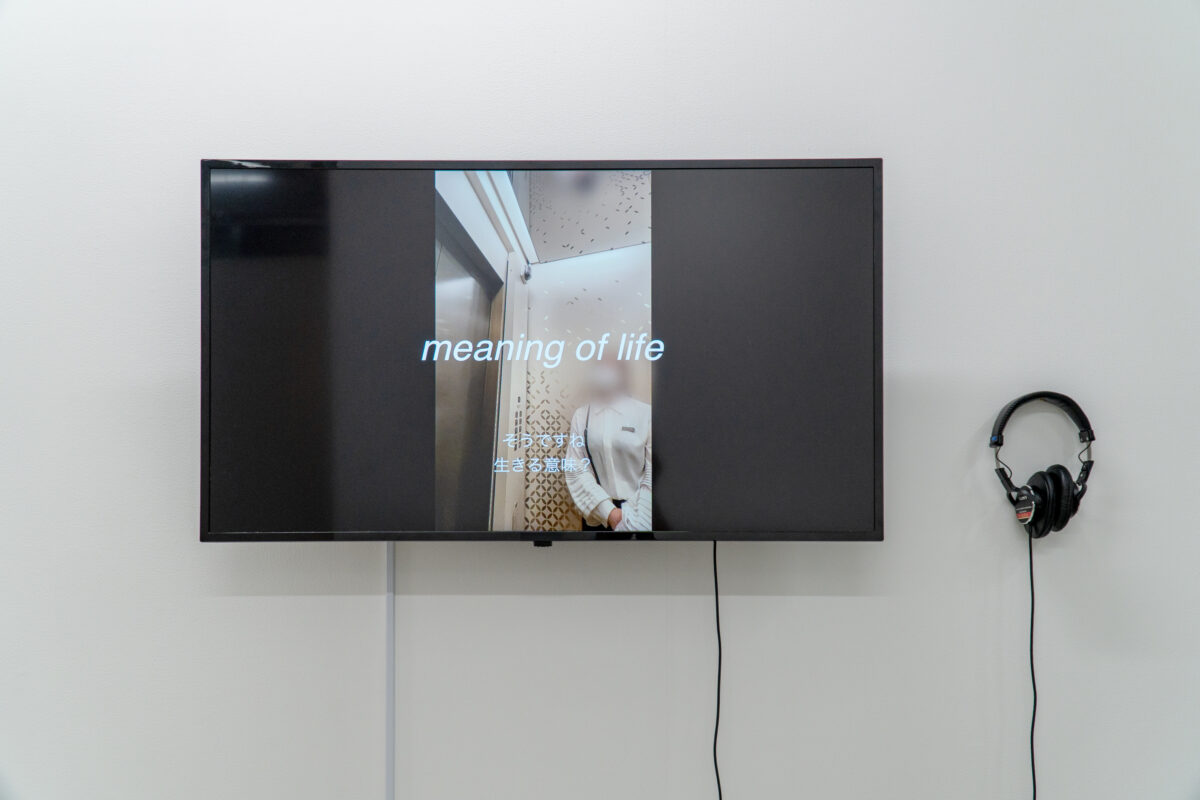
This research was brought together in the solo exhibition Swept Along, but Not Swept Away (COURTYARD HIROO Gallery, November 2024; supported by the Agency for Cultural Affairs’ Media Arts Creator Fostering Support Program, FY2024) and in the written commentary for my master’s graduation work, “Swept Along, but Not Swept Away: Active Drifting, Passive Response” (chief examiner: Kazuhiko Hachiya; examiners: Tsuyoshi Ozawa and Yoshinari Nishio). The graduation work consists of four pieces. Traveling With One Smartphone (2017–) is an attempt to cross borders carrying nothing but a single smartphone, improvising responses to the chance events that arise from deliberate vulnerability. Are you looking for something? (2022) is a performance that derails a shop assistant’s question “Are you looking for something?”, turning a conversation meant to lead to a purchase into a philosophical dialogue. In The Railway Walk (2024), I walk unsteadily along railway tracks—a symbol of efficiency and straightness—laid through a forest, a place of getting lost. Swept along, but not swept away (2024) is an instruction piece in which postcards of 259 countries and regions are handed out one by one, turning viewers themselves into the subjects of drifting.




This interest in walking and movement has also extended beyond the university. From 2021, I carried out joint research at FUTURE GATEWAY, a research base of KDDI Research, Inc., examining the psychological barriers to travel and how they might be loosened (details are on the Traveling With One Smartphone page). From 2025, I began joint research with Japan Tobacco (JT) D-LAB toward creating contemporary artworks that start from walking.
The conclusion I drew from this series of research is an attitude of neither withdrawing completely from the system nor continuing to resist it, but of remaining within it while continuing to find room for unpredictability and chance. Thoreau called this a way of life that remains forever on the way. Rather than setting a purpose first, it is by surrendering ourselves to the arrival of something beyond us that purpose comes to be discovered. This inquiry continues today.